RESEARCH CONSOLE / 02

The CJC-1295 research record: mechanism, GH and IGF-1, and the GHRH-analog class.

What the published literature established — receptor pathway, human pharmacokinetics, the preclinical anchors, and the two-receptor pairing rationale. Each finding tagged to a study.

How CJC-1295 works: the GHRH-receptor pathway

CJC-1295 binds the growth-hormone-releasing hormone receptor (GHRHR), a class B G-protein-coupled receptor on anterior-pituitary somatotrophs [1]. Receptor activation drives Gs/cAMP/PKA signaling, which through CREB-driven transcription stimulates synthesis and pulsatile release of GH; circulating GH then acts on the hepatic GH receptor via JAK2/STAT5 to raise IGF-1 [1][2]. The cascade is the same one native GHRH uses — CJC-1295 is an agonist at the receptor, not a novel pathway.

What the molecule adds is durability. The four substitutions on hGRF(1-29) make it resistant to DPP-IV, the protease that rapidly clears native GHRH [3]. In the DAC variant, covalent binding to serum albumin extends plasma residence so that GHRH-receptor stimulation is sustained over days rather than minutes [1][3]. The albumin conjugate was identified and characterized in rats: in vitro it was DPP-IV-stable, in vivo it remained detectable in plasma beyond 72 hours, and it produced a 4-fold increase in GH area-under-the-curve over two hours versus unconjugated hGRF(1-29) [3]. That rat work is what established CJC-1295 as the lead long-acting GRF analog in the series.

What the Research Reports on GH and IGF-1

The human pharmacokinetic record is consistent. In healthy adults aged 21-61, single subcutaneous doses of 30 or 60 ug/kg produced dose-dependent 2- to 10-fold increases in mean plasma GH for six days or more, and 1.5- to 3-fold increases in IGF-1 for nine to eleven days; after multiple doses, IGF-1 remained above baseline for up to 28 days, with an estimated CJC-1295 half-life of 5.8-8.1 days [1].

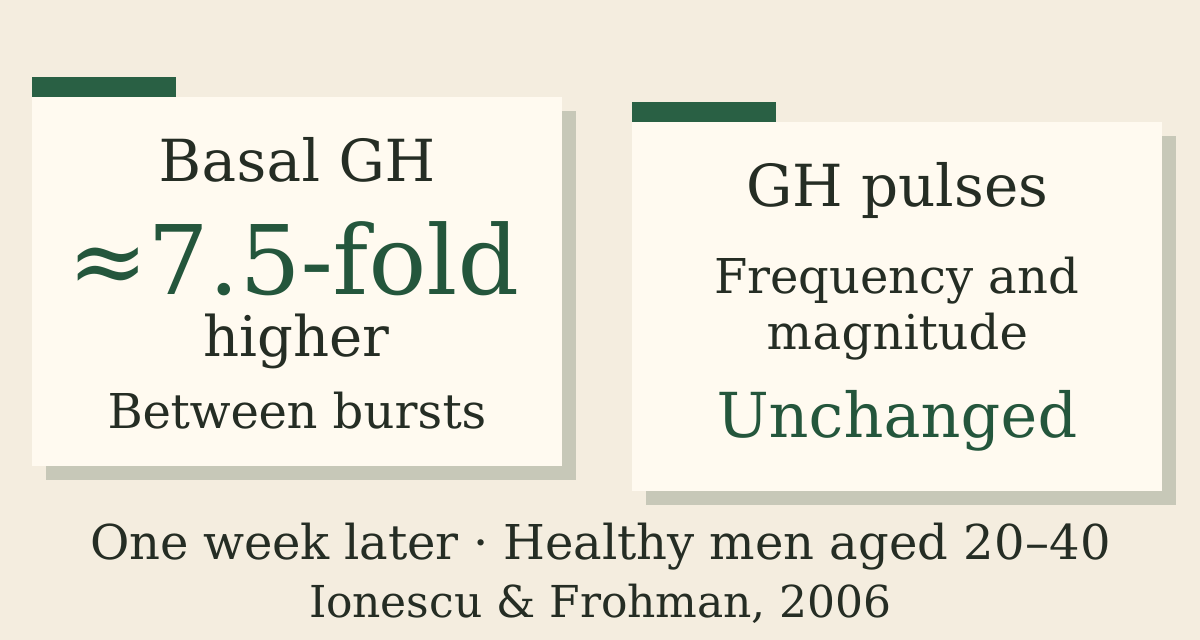
In a second study in healthy men aged 20-40, a single 60- or 90-ug/kg dose raised trough/basal GH approximately 7.5-fold, mean GH by about 46%, and IGF-1 by about 45% one week later — while the frequency and magnitude of pulsatile GH secretion were unaltered [2]. That is the central pharmacological observation: GH pulsatility persists under continuous GHRH-analog stimulation [2]. Preserving the pulse matters because the body's GH signaling is tuned to episodic, not flat, exposure.

These GH and IGF-1 elevations are the documented research findings. They are not a statement of human benefit, and they were measured in small PK studies in healthy volunteers, not in efficacy trials [12]. A proteomic study in 11 healthy young men found reproducible serum protein shifts after CJC-1295 — decreased apolipoprotein A1 and a transthyretin isoform, increased albumin-fragment and immunoglobulin species — with the immunoglobulin/albumin-fragment signal correlating linearly with IGF-1, identifying candidate biomarkers of GH/IGF-1 axis activation [5]. In other words, the IGF-1 rise leaves a measurable downstream fingerprint, but a fingerprint is not a clinical result.

The preclinical anchor: once-daily dosing normalizes growth

The clearest preclinical result comes from GHRH-knockout mice. Two micrograms of CJC-1295 given once every 24 hours fully normalized body weight and length; dosing every 48 or 72 hours was progressively less effective, and treatment increased pituitary GH mRNA [4]. The result demonstrates that the long-acting analog's once-daily schedule is sufficient to restore GH-axis-dependent growth in a model lacking endogenous GHRH [4]. It also shows the dosing interval is bounded by the half-life: stretch the interval and the effect decays.

A separate line of evidence comes from analytical chemistry: CJC-1295 was structurally identified by high-resolution LC-MS/MS as the active ingredient in an unknown 'GHRH' pharmaceutical preparation seized in an anti-doping context [6]. That confirms both the molecule's identity in circulation and its standing as a prohibited substance in sport — detection assays for it are well established [6].

Where CJC-1295 Sits Among GHRH Analogs

CJC-1295 belongs to the GHRH-analog class, alongside sermorelin and the FDA-approved tesamorelin (approved for HIV-associated lipodystrophy) — the closest approved-drug comparator [7]. A 2024/2025 Nature Reviews Endocrinology review synthesizes the pharmacology of GHRH and its synthetic analogues, describing receptor signaling, the rationale for long-acting analog design, and their therapeutic and investigational landscapes [7]. The legitimate clinical context for any GHRH-axis intervention is growth-hormone deficiency, and a 2024 update on adult GH-deficiency management frames how that condition is diagnosed and treated [12].

What distinguishes CJC-1295 within the class is the DAC albumin-conjugation strategy and the resulting multi-day duration of action [1][3]. Sermorelin is short-acting GHRH(1-29); tesamorelin is a stabilized analog approved for a narrow indication; CJC-1295 DAC is the bioconjugate built specifically for sustained exposure. Where CJC-1295 differs from its approved cousins is not chiefly mechanism but regulatory standing and the depth of the human evidence base.

CJC-1295 and Ipamorelin: The Two-Receptor Rationale

The most common research pairing combines a GHRH analog (CJC-1295) with a growth-hormone-releasing peptide, or GHRP — ipamorelin — that acts on a separate target, the ghrelin/growth-hormone-secretagogue receptor [3]. The logic is that two receptors driving the same somatotroph can produce more GH release together than either alone: GHRH analogs raise the amplitude of GH pulses through the GHRHR, while GHRPs act through the ghrelin receptor and can amplify the same pulse.

That two-receptor rationale is mechanistically grounded, and CJC-1295 alone reliably raises GH and IGF-1 in PK studies [1][2]. But the synergy argument rests on mechanism and on single-agent data, not on a controlled trial of the pair — there are no controlled human efficacy trials of the specific CJC-1295 + ipamorelin combination [12]. Community 'protocols' that cite fixed combination doses are not derived from controlled human trials, and no validated human combination dose exists [12].

Reported and Theoretical Side Effects

Human side-effect data for CJC-1295 specifically are sparse, because the human record is limited to early PK studies in healthy volunteers [1][12]. The reported and theoretical concerns derive from what GH-axis stimulation does in general, and from the development history of the molecule.

GH increases extracellular fluid volume by stimulating renal sodium reabsorption in the distal nephron — the mechanism behind the fluid-retention and edema effects associated with GH-axis stimulation [9]. A GHRH analog studied clinically influenced GH pulsatility and insulin sensitivity, part of the human GHRH-analog evidence base [8]. GH and GH-secretagogue effects on nitrogen balance and substrate metabolism have also been characterized [10]. Sustained elevation of IGF-1 raises theoretical long-term questions — epidemiology links higher IGF-1 to modestly increased risk of certain cancers — that the short human studies were not designed to answer [12].

Two development-history points belong in any honest side-effect summary. The original long-acting DAC program (ConjuChem) was discontinued, and a Phase 2 trial in HIV-associated visceral obesity (NCT00267527) did not advance; a patient death during the development era is frequently cited in connection with the halted program, though a causal link to CJC-1295 was not established in the public record. And FDA briefing materials for the 2024 Pharmacy Compounding Advisory Committee cited immunogenicity and other safety concerns for GH secretagogues including CJC-1295. None of this is a complete safety profile, because none exists [12].

What does the research describe happening?

In human PK studies, single subcutaneous doses produced multi-fold increases in GH and roughly 45% increases in IGF-1 a week later, with effects lasting days [1][2]. These are research observations in healthy volunteers, not human-use expectations; no efficacy or long-term outcome was measured [12]. A 2026 review assessed the safety and efficacy of approved and unapproved peptide therapies for musculoskeletal indications, directly addressing the evidence gap for unapproved GH-axis peptides [13]. The accurate framing is narrow: the literature describes a hormone-kinetics signature, cleanly measured, and stops short of any claim about what that signature produces in practice.